

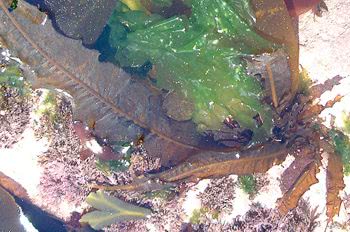
This brown alga is confused with the kelps but Dabberlocks has a very strong, flattened midrib that runs the length of the frond. A frilled, thinner lamina is on either side. On average, up to 70 cm long, although this varies enormously . Above the holdfast and below where the lamina starts there is a circle (bunches) of reproductive bodies and in late summer this is often all that remains of the plant as the main frond has been shredded by wave action. In areas of extreme wave action Dabberlocks may replace kelp altogether. The very tough midrib gives it the strength along the length of the frond to withstand the destructive forces of the water. In areas where the wave action is moderate it can grow to much greater lengths and widths (I have seen ones several metres in length on East Scottish coast). This is a species of the lower shore on rocky outcrops which are exposed to heavy wave action, and found in the north Atlantic and North Sea although it is most abundant on west coasts.
Looking for a next step?
The FSC offers a range of publications, courses for schools and colleges and courses for adults, families and professionals that relate to the seashore environment. Why not find
out more about the FSC?

FEEDBACK
Do you have any questions?
Copyright © 2008 Field Studies Council

Creative Commons Attribution-Noncommercial-No Derivative Works 3.0 Licence .
Site Statistics by Opentracker
