

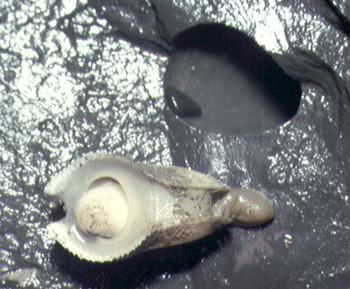
A piddock next to its rock burrow. The muscular foot is visible on the left.
These are unusual molluscs. A bivalve living on a rocky shore that bores into the substrate, be it wood or rock. The Common Piddock (Pholas dactylus) is a 15 cm long bivalve capable of boring into rock. The shell is wonderfully adapted to do this as there are strong teeth at one end of the oval shells, the muscular foot is permanently exposed to grab the rock and rotate the shells back and forth to cut into the substrate.
Piddocks are quite remarkable bivalves as they remain deep inside the burrow all their lives, which gives protection, and as they age so the burrow gets wider. Through the small outlet hole in the rock it extends siphons to the outside. One of these draws in water whilst the other takes it out. These are suspension feeders and so oxygen and suspended matter (food) comes in with the water and waste leaves. Pholas is an animal that displays phosphorescence, i.e. whilst in the burrow it shines a greenish light! When the larva settles out of the plankton it behaves a little like mussels, by attaching to the rock by byssus threads. Later, these are lost. This is a southern species which has a range extending up from the Mediterranean to the UK.
Looking for a next step?
The FSC offers a range of publications, courses for schools and colleges and courses for adults, families and professionals that relate to the seashore environment. Why not find
out more about the FSC?

FEEDBACK
Do you have any questions?
Copyright © 2008 Field Studies Council

Creative Commons Attribution-Noncommercial-No Derivative Works 3.0 Licence .
Site Statistics by Opentracker