

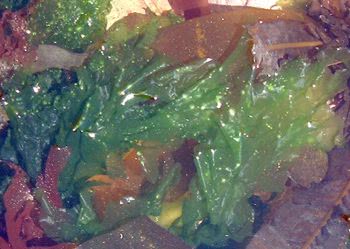
This is a light green alga and forms a sheet of undifferentiated tissue two cells thick. It can be up to 40 cm long but invariably smaller.
The Sea Lettuce may form very dense patches on the seashore especially in mid-summer. It does not have a particular zone and can recover from desiccation to full metabolism in a very short time. It can be very abundant under brown algae where the large seaweed gives it some protection. In estuaries the nitrate levels can become very high, early in the summer, from fertilisers leached from farmland. This can cause an explosive growth of Sea Lettuce turning the mudflats into a green "meadow". The gametes are produced along the edges of the green sheet of tissue.
The Sea Lettuce is a very abundant alga which grows across mudflats, in estuaries and attached to hard substrates on a rocky seashore. It is found throughout the coastline of Europe including the Mediterranean
Looking for a next step?
The FSC offers a range of publications, courses for schools and colleges and courses for adults, families and professionals that relate to the seashore environment. Why not find
out more about the FSC?

FEEDBACK
Do you have any questions?
Copyright © 2008 Field Studies Council

Creative Commons Attribution-Noncommercial-No Derivative Works 3.0 Licence .
Site Statistics by Opentracker