

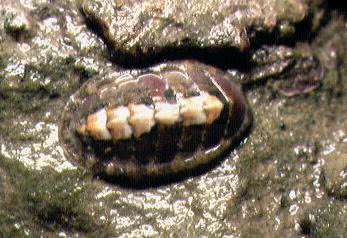
Chitons (or coat-of-mail shells) have eight overlapping plates over an oval body. They are flexible and with the muscular foot attach themselves to rock. The soft mantle protrudes from under the plates. No obvious head. Usually the body is less than 1 cm long.
It is somewhat similar to the limpet in the way it grips the rock and grazes over surface. However, it is small and easily overlooked as it merges with the background so well. Unlike the limpet there are no eyes or tentacles on the head. Feeding is similar to limpets, grazing on microscopic algae on the rocks. The teeth of the radula are toughened iron extensions that allow it to feed on quite tough algae, unlike the limpets.
The Polyplacophora are a primitive group of molluscs and most of the species are tropical where they grow to 10 cm or more. Lepidochitona is the commonest species and found on middle and lower zones of rocky seashores. They keep in the damper crevices and, occasionally, pools. Widespread on most coasts including the Mediterranean. They may be eaten by crabs and fish.
Reproduction is through separate sexes that discharge their eggs directly into teh sea where external fertilisation occurs.
Looking for a next step?
The FSC offers a range of publications, courses for schools and colleges and courses for adults, families and professionals that relate to the seashore environment. Why not find
out more about the FSC?

FEEDBACK
Do you have any questions?
Copyright © 2008 Field Studies Council

Creative Commons Attribution-Noncommercial-No Derivative Works 3.0 Licence .
Site Statistics by Opentracker