

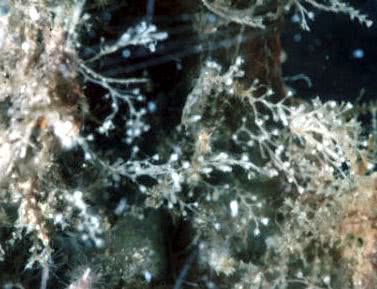
These delicate, plant-like organisms are actually colonies
of very small sessile animals. They are sedentary and look more like
delicate seaweeds. Each tiny individual is a small polyp like
a sea anemone, with tentacles around a small bag. These are formed
together on a stalk. The arrangement on the stalk varies between
the species.
Clava is exquisite forming pink clusters of polyps on a soft extensible
stalk. Dynamena has a stiff stalk and is a short hair like colony
with the polyps coming off in pairs, opposite each other on the
stalk. Obelia has polyps alternating down the stalk.
Like jellyfish they tend to have two phases in the
life cycle: a polyp stage and a medusa stage. The latter is the
dispersal and sexual phase whilst the first is the growth and
asexual phase. As the hydroid colony grows so some of the polyps
produce a medusa - a minute jellyfish which swims off and produces
sperm and eggs. The resulting larvae hatching from the fertile
egg, lands on the shore and, stimulated by a positive response
to light, it establishes a new colony of polyps. New polyps are
added by asexual reproduction. The feeding polyps collect plankton
and after digestion disperse the food amongst the colony.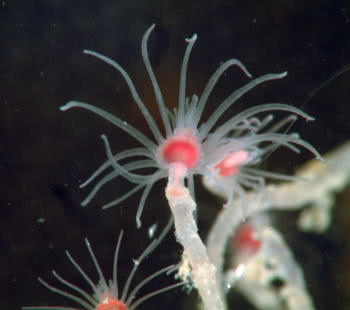
Tubularia sp. up close
They are usually attached to rock, seaweeds or even animals. Clava is commonly found on Knotted and Serrated Wrack and is limited to the western Atlantic coast of Europe. Dynamena and Obelia can be very abundant on just about any suitable substrate and are the most widespread species including the Mediterranean
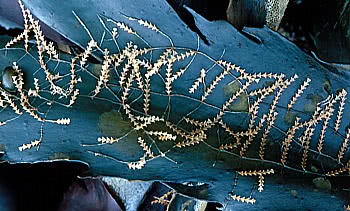
Dynamene on Serrated Wrack
Looking for a next step?
The FSC offers a range of publications, courses for schools and colleges and courses for adults, families and professionals that relate to the seashore environment. Why not find
out more about the FSC?

FEEDBACK
Do you have any questions?
Copyright © 2008 Field Studies Council

Creative Commons Attribution-Noncommercial-No Derivative Works 3.0 Licence .
Site Statistics by Opentracker