

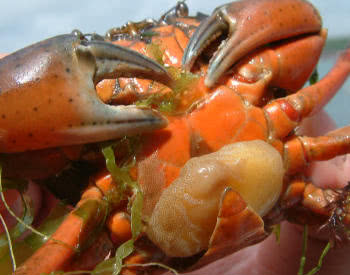
This is a parasitic crustacean which manifests itself as a small orange-yellow bag under the abdomen. The bulk of the parasite consists of threads which pervade the inside of the body of the crab.
The planktonic larva settles out like other barnacles (to which it is related) but instead of rock it uses the Common Shore Crab (Carcinus maenas). After boring into the crab the female parasite sets up fine internal threads to feed on the host's fluids. The male planktonic larva penetrates the outer bag and parasitises the female, forming a kind of large testis in her body. The effect on the host crab depends on its sex. Male hosts are made sterile. Female hosts behave like an individual carrying eggs and migrates into deeper water.
The parasite is very widespread in the waters around Europe but because the infected crab is stimulated to move into deeper water it may not be easily encountered on the seashore. Estuaries and rocky seashores.
More detailed information of the life cycle can be found in A Student's Guide to the Seashore by Fish & Fish, Cambridge, 1996.
Looking for a next step?
The FSC offers a range of publications, courses for schools and colleges and courses for adults, families and professionals that relate to the seashore environment. Why not find
out more about the FSC?

FEEDBACK
Do you have any questions?
Copyright © 2008 Field Studies Council

Creative Commons Attribution-Noncommercial-No Derivative Works 3.0 Licence .
Site Statistics by Opentracker
