

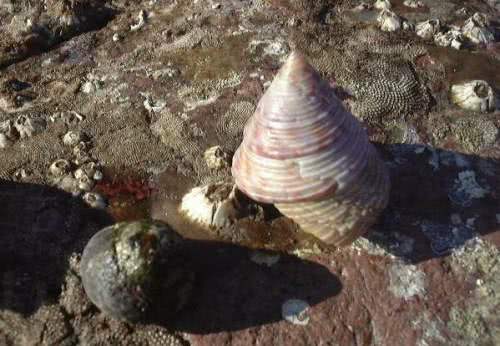
This is a large group of colourful seashells. The inside lip of the shell has a "Mother-of-Pearl" effect of multiple colours. The Purple Topshell (Gibbula umbilicalis) is probably the most widespread species and is around 15 mm tall. This topshell species has a hollow spiral through the centre of the shell (the hole can be seen when turned over). The horny plate, the operculum, closes across the shell opening to reduce the water loss at low tide. This is similar in the other topshells. The Grey Topshell (Gibbula cineraria) is 12 mm tall and it lacks the purple banding of G. umbilicalis and the hole beneath the shell is small. The Painted Topshell (Calliostoma zizyphinum) is a beautiful cone shaped shell.
They are all important herbivores. They feed, like many of the seashore herbivores, on the Fucus. They have separate sexes which do not mate but release gametes into water, for external fertilisation. The fertilised egg hatches into a planktonic larva. The Painted Topshell, unlike other topshells, does not have the larval stage. Mini-adults are born directly on to the shore. The Grey Topshell lacks the tolerance to environmental stress like other Gibbula species and is found lower down the shore.
The Purple Topshell is abundant across the middle seashore on the various seaweeds. Painted Topshells are common on the lower shore, especially amongst holdfasts. The Grey Topshell is also a lower shore species. All live in rocky seashore habitats and are widespread across European coasts. All except the Purple Topshell are found in the Mediterranean
Looking for a next step?
The FSC offers a range of publications, courses for schools and colleges and courses for adults, families and professionals that relate to the seashore environment. Why not find
out more about the FSC?

FEEDBACK
Do you have any questions?
Copyright © 2008 Field Studies Council

Creative Commons Attribution-Noncommercial-No Derivative Works 3.0 Licence .
Site Statistics by Opentracker