

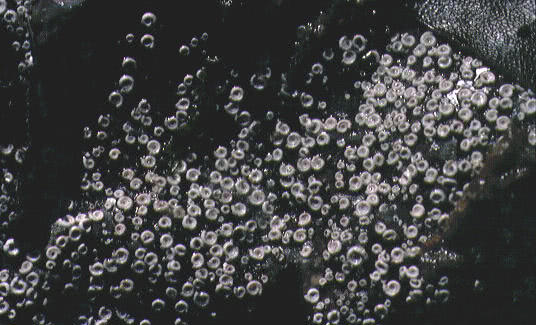
Tiny tubes of the worm Spirorbis
Hydroides produces a colony of worms on rocks with the tubes of calcium all inter-twined. They are round in section and 3 - 5 mm in diameter. By contrast the Spirorbis tubes are symmetrical, flat coils and attached to the large brown seaweeds, particularly Fucus. Coils are just a few millimetres across. Pomatoceros (the Keeled Tubeworm) is a common species found higher on the seashore on rocks. The single tube is triangular in section.
These sedentary worms are filter feeders. Using the tentacles which are extended out of the tube at low tide they collect material suspended in the water, mainly detritus and plankton
These many and varied tube worms are very abundant in the lower shore although Hydroides lives in deeper water and only found at extreme low tide. They are found throughout the European coastline, mainly on rocky seashores although anywhere where there is a suitable substrate to attach the tube. The tubes are porous and this will confine them to the lower shore to avoid desiccation.
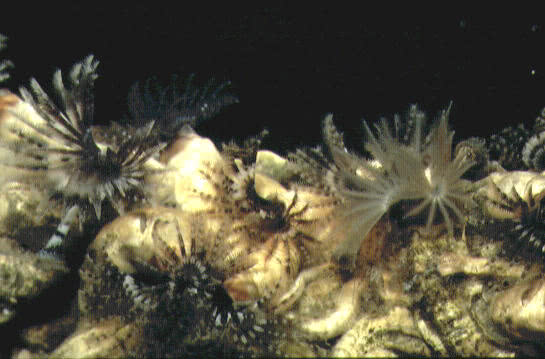
Tentacles out feeding under water - Hydroides, a fan worm
Looking for a next step?
The FSC offers a range of publications, courses for schools and colleges and courses for adults, families and professionals that relate to the seashore environment. Why not find
out more about the FSC?

FEEDBACK
Do you have any questions?
Copyright © 2008 Field Studies Council

Creative Commons Attribution-Noncommercial-No Derivative Works 3.0 Licence .
Site Statistics by Opentracker
