


Did you know the FSC publishes fold out charts and guides? Find out more.
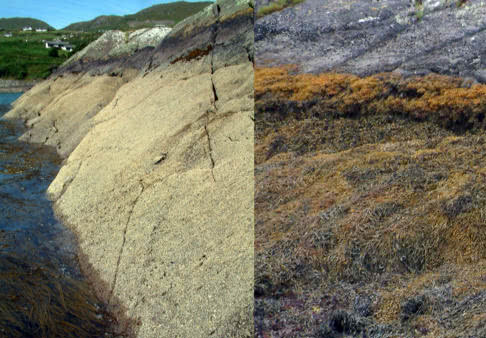
Two shores: on the left is one very exposed to wave action; right, a very sheltered shore. Note the high density of seaweeds on the sheltered one. See the Ballantine Exposure Scale
Usually face away from the open sea and the prevailing wind. This means they generally have smaller waves than exposed shores which face out into the open sea and the prevailing wind. The prevailing wind in Britain is from the south-west and so here on the west coast of Wales our exposed shores are usually on south to south westerly facing shores and our sheltered shores are usually on north to north easterly facing shores. North facing sheltered shores get less sunlight than exposed ones, are less susceptible to desiccation and in general are more hospitable places for inter-tidal organisms. Because reality is never as simple as we imagine there are exceptions. Off-shore reefs or islands for example can shelter shores that would otherwise endure heavy wave action.
Find out more about the zones by clicking below:
Looking for a next step?
The FSC offers a range of publications, courses for schools and colleges and courses for adults, families and professionals that relate to the seashore environment. Why not find
out more about the FSC?

FEEDBACK
Do you have any questions?
Copyright © 2008 Field Studies Council

Creative Commons Attribution-Noncommercial-No Derivative Works 3.0 Licence .
Site Statistics by Opentracker